
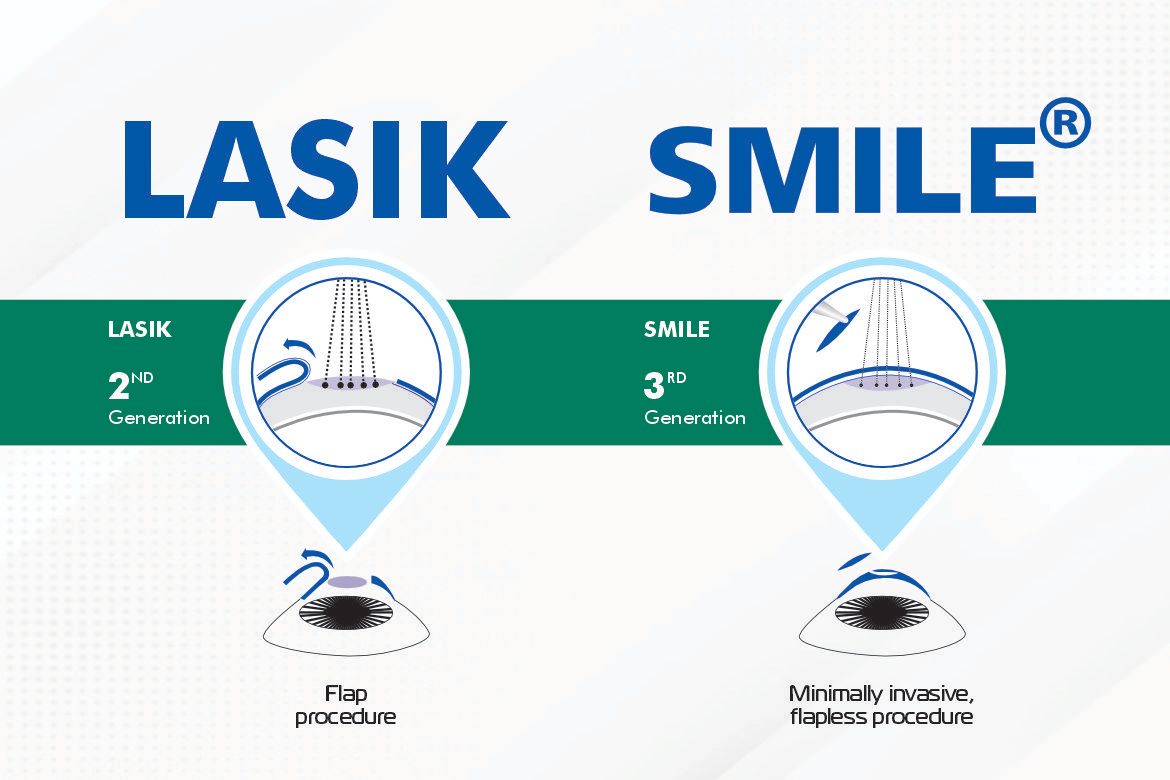
If you’re tired of relying on glasses or contact lenses for clear vision, you may have come across two widely popular refractive procedures: SMILE and LASIK. These advanced techniques have revolutionised laser vision correction, offering freedom from the hassles of specs and contact lenses. Let’s delve deeper into the SMILE vs LASIK comparison, helping you make an informed decision about which procedure is best suited for your needs.
Understanding SMILE And LASIK
SMILE and LASIK are refractive procedures designed to correct common vision problems such as nearsightedness, farsightedness, and astigmatism, with the range of treatable prescriptions depending on the procedure and individual eye characteristics. Let’s take a closer look at each technique.
SMILE Eye Surgery
SMILE, an acronym for “Small Incision Lenticule Extraction,” is a newer technique that has gained popularity in recent years. Unlike LASIK, SMILE procedure is a minimally invasive procedure that involves creating a small, precise incision to access and remove a tiny lenticule within the cornea. By removing the lenticule, the cornea’s shape is altered, correcting the refractive error.
Benefits: It is a minimally invasive, flap-free technique that preserves corneal strength, reducing the risk of dry eyes and other complications, and boosting faster recovery.
LASIK Eye Surgery
LASIK, short for “laser-assisted in situ keratomileusis,” is a well-established and widely performed procedure. During LASIK, a thin flap is created on the cornea, and a laser is used to reshape the underlying tissue. This allows light to focus properly onto the retina, resulting in clearer vision.
Benefits: The surgery offers quick recovery, often within a day, and enhances visual acuity, allowing many patients to achieve clear, sharp vision without eyewear.
What Is the Difference Between SMILE AND LASIK?
While both SMILE and LASIK aim to improve vision, they differ in several aspects. In the SMILE vs LASIK comparison, here are the major differences.
| Aspects | SMILE | LASIK |
| Procedure Type | Refractive Surgery | Refractive Surgery |
| Flap Creation | No flap creation | Corneal flap is created |
| Laser Type | Femtosecond laser | Excimer Laser |
| Vision Correction | Corrects myopia and astigmatism | Corrects Myopia, Hyperopia, Astigmatism |
| Procedure Duration | Quick (Both eyes can be treated in one session) | Quick (Both eyes can be treated in one session) |
| Recovery Time | Very quick (one day rest is enough) | Quick (Usually within a week) |
| Vision Improvement | Impeccable vision improvement | Good vision improvement |
| Discomfort During Procedure | Minimal discomfort as no flap creation is involved | Little discomfort |
| Complications and Risks | Minimal complications, dry eyes, halos, and glare | Little Flap-related complications, dry eyes, glare, halos, and infections |
| Patient Feedback | High patient satisfaction rate. | Positive patient feedback |
SMILE vs LASIK: Temporary Side Effects and Recovery
In the comparison between SMILE vs LASIK, understanding the distinctions in their approaches and temporary side effects is crucial for individuals considering laser eye surgery as a means to enhance their visual acuity.
| ASPECT | SMILE | LASIK |
|---|---|---|
| Temporary Side Effects | Dry eyes (Lesser) | Dry eyes |
| Light sensitivity (Lesser) | Light sensitivity | |
| Halos and Glare (Lesser) | Halos and Glare | |
| Slight discomfort and pain | Slight discomfort and pain | |
| Return to Normal Activities | May take a bit longer | Typically within one or two days |
| Prescription Eye Drops | Eye drops may be prescribed for a shorter time | Maybe required for a few days |
| Contact Lenses | Avoided during the recovery time | Usually avoided during the initial recovery |
| Visual Acuity Improvement | Noticeable improvement in the following weeks | Significant improvement within a short time |
| Patient Experience | Mild discomfort | Mild discomfort |
| Overall Recovery Experience | Positive feedback for effectiveness | Positive feedback for rapid improvement |
| Flap-Related Complications | Not possible as it is a flapless procedure | Rare |
Which Is Better: SMILE or LASIK?
In comparison, both popular laser eye surgery procedures, i.e., SMILE vs LASIK are developed to correct refractive errors and reduce dependence on glasses or contact lenses. The choice between them must depend on various factors, including individual eye characteristics, preferences, and the surgeon’s recommendation.
Choosing the Right Procedure
Know the key difference between SMILE and LASIK and consider the following points, before you undergo either of the surgery.
LASIK EYE SURGERY:
- Procedure:
LASIK involves creating a thin flap on the cornea, folding it back, and then reshaping the underlying corneal tissue with a laser. The flap is then repositioned, and the cornea begins to heal.
- Recovery:
Recovery is relatively quick, and patients often experience improved vision within a day or two. Discomfort is minimal.
- Suitability:
LASIK is suitable for a wide range of refractive errors, including nearsightedness, farsightedness, and astigmatism.
- Corneal Thickness:
LASIK may be preferred for individuals with thinner corneas, as it typically involves less tissue removal compared to some other procedures.
SMILE EYE SURGERY:
- Procedure:
SMILE is a flapless procedure that involves creating a small incision in the cornea to extract a lenticule, reshaping the cornea in the process. This procedure is designed to be minimally invasive.
- Recovery:
Recovery is quick and as the procedure is flapless, postoperative restrictions are limited. Discomfort is generally mild.
- Suitability:
SMILE is suitable for treating nearsightedness, and its application for astigmatism and farsightedness is evolving.
- Corneal Thickness:
SMILE may be considered for individuals with thicker corneas as it involves less disruption to the corneal surface.
After The Refractive Procedure
Now that you have understood the major differences between Smile and LASIK surgery, you can choose the right type of surgery for yourself. Below are the things to keep in mind after the refractive surgery
- Embrace a New Vision of Life: Once you’ve undergone a successful refractive procedure, a world of possibilities awaits you. Here are a few interesting things you can look forward to:
- Active Lifestyle: Engage in sports, outdoor activities, and hobbies without the limitations of glasses or contact lenses. From swimming to playing basketball, your new visual freedom opens doors to a more active and enjoyable
- Travel with Ease: Say goodbye to the hassle of packing extra pairs of glasses or worrying about losing contact lenses while exploring new destinations. With clear vision, you can fully immerse yourself in the beauty of the world around
- Fashion Freedom: Enjoy the freedom to experiment with different styles of sunglasses and eyewear. Enhance your fashion sense and express your personality through a wide range of frames, without the constraints of prescription
While comparing SMILE vs LASIK, remember that every eye is unique, and what may be the best refractive procedure for your eye might not be the same for another person.
Key Considerations in Choosing Between SMILE and LASIK Surgery
Choosing the right procedure between SMILE and LASIKrequires so much carefulness and deep consideration. To help individuals make informed decision, here we have listed a list of factors to consider, such as:
- Medical history and eye health
- Kind of refractive error
- Personal preferences and lifestyle
- Needs and visual expectations
- Eye institute and the ophthalmologist
Real Patient Stories
Seven years back, I used to wear eyeglasses & contact lenses, but then I got SMILE Eye Surgery done at Centre For Sight. The entire procedure was seamless & quick, and even my vision was completely restored. It really transformed my life! So, don’t hide your beautiful eyes behind eyeglasses. – Bollywood Actress Bipasha Basu
I want to get rid of my glasses and contact lenses and hence decided to go for LASIK eye surgery from Planet Lasik. My experience was great and I am happy with the results. – Pratiksha
Conclusion:
Once you’ve undergone a successful refractive procedure, a world of possibilities awaits you. From an active lifestyle, free from the constraints of glasses or contact lenses, to the convenience of traveling without the burden of extra visual aids, and the freedom to express yourself through fashionable eyewear, your new vision will open doors to a brighter future.
The decision to undergo a refractive procedure is a personal one, and it’s essential to make an informed choice. By partnering with a trusted and reputable eye care provider, you embark on your vision correction journey with confidence, knowing that you’re in the hands of experts who prioritize your eye health and well-being. So, take the first step towards a clearer vision and a better quality of life. Consult with experienced ophthalmologists at PLANET LASIK, powered by Centre For Sight.
Embrace the exciting possibilities that await you after your refractive procedure, book your consultation at https://planetlasik.com/
SMILE vs. LASIK FAQs
Are there any age restrictions for SMILE or LASIK?
Both SMILE and LASIK generally have no strict age restrictions, but candidates should be at least 18 years old with stable vision for a certain period. The suitability for either procedure depends on individual eye health and the recommendation of an eye care professional.
Can I still wear contact lenses after either procedure?
Yes, in many cases, you can still wear contact lenses after LASIK or SMILE, but it’s essential to consult with your eye surgeon. Some individuals may no longer need contacts, while others might use them occasionally for specific reasons.
How long do the effects of SMILE and LASIK last?
Both SMILE and LASIK typically provide long-lasting vision correction, but individual outcomes vary. Regular eye check-ups are advised to monitor any potential changes in vision.
Can I get either procedure if I have astigmatism?
Yes, LASIK is generally suitable for astigmatism correction, while SMILE is evolving for this purpose. Consult with an eye surgeon to determine the best option based on your specific astigmatism and overall eye health.
Is SMILE better than LASIK?
Neither procedure is universally better. In the SMILE vs LASIK comparison, SMILE has the advantage of being flapless, which means fewer flap-related complications and potentially less dry eye after surgery. LASIK has the advantage of treating a wider range of refractive errors, including farsightedness, and has a longer track record. The right choice depends on your prescription, corneal thickness, lifestyle, and your surgeon’s recommendation. Consult with an ophthalmologist at Planet LASIK to determine which procedure suits your eyes.