
Key Takeaways
- The types of eyeglass lenses divide by job, not by price: single vision lenses for one distance, bifocal lenses for two, progressive lenses and trifocals for the whole range.
- Across eyeglass lens types, material decides weight, thickness and safety. Polycarbonate and Trivex resist impact, high-index lenses keep a strong prescription thin, and glass gives the best optics but breaks.
- Coatings do more for daily comfort than most people expect. Anti-reflective coating and UV protection earn their cost. The evidence behind blue light blocking lenses is thin.
- How to choose eyeglass lenses comes down to what you do all day, not what the display card says. A night driver, a nine-hour screen user and an outdoor worker need three different lenses from the same prescription.
- Children need polycarbonate or Trivex with scratch-resistant and UV coating. Glass has no place in a child’s frame.
- The best eyeglass lenses last one to two years. Coatings haze, and prescriptions move.
- If you are tired of replacing lenses altogether, LASIK, SMILE, Contoura Vision, SmartSurf and ICL correct the prescription itself. Suitability is decided at an assessment.
Choosing the Right Type of Eyeglass Lens
With so many different types of eyeglass lenses available in India and other parts of the world, it can be overwhelming to figure out which is best for you. That’s why we’ve created this comprehensive guide to help you understand the different types of optical lenses for glasses and how to choose the perfect option for your vision and lifestyle needs.
Get a thorough eye check-up at Planet Lasik!
Understanding Your Prescription
Before diving into the types of lenses for glasses, let’s understand your prescription. This document provided by your eye doctor specifies the lens power required to correct your vision. It includes elements such as sphere, cylinder, and axis, which indicate whether you have nearsightedness, farsightedness, astigmatism, or a combination of these conditions. Having a clear understanding of your prescription will enable you to communicate effectively with your optician and decide which type of spectacle lens will best suit your needs.
Types of Eyeglass Lens Materials Available in India
The lens material you choose can significantly impact the comfort and durability of your glasses. Each material comes with its own advantages and disadvantages, depending on your lifestyle and prescription strength. These are the most common types of eyeglass lens materials available in India:
- Glass: Known for its excellent optics but heavier and more prone to breakage.
- Plastic: A popular choice for everyday wear due to its lighter weight and impact resistance.
- Polycarbonate: Ideal for those with an active lifestyle or children, as it is highly impact-resistant.
- Trivex: Offers superior optical clarity and is both lightweight and durable, making it a good option for those with stronger prescriptions.
Types of Eyeglass Lenses
Now that you know how to understand your prescription and the types of lens materials available in India, let’s explore the different types of lenses for glasses.
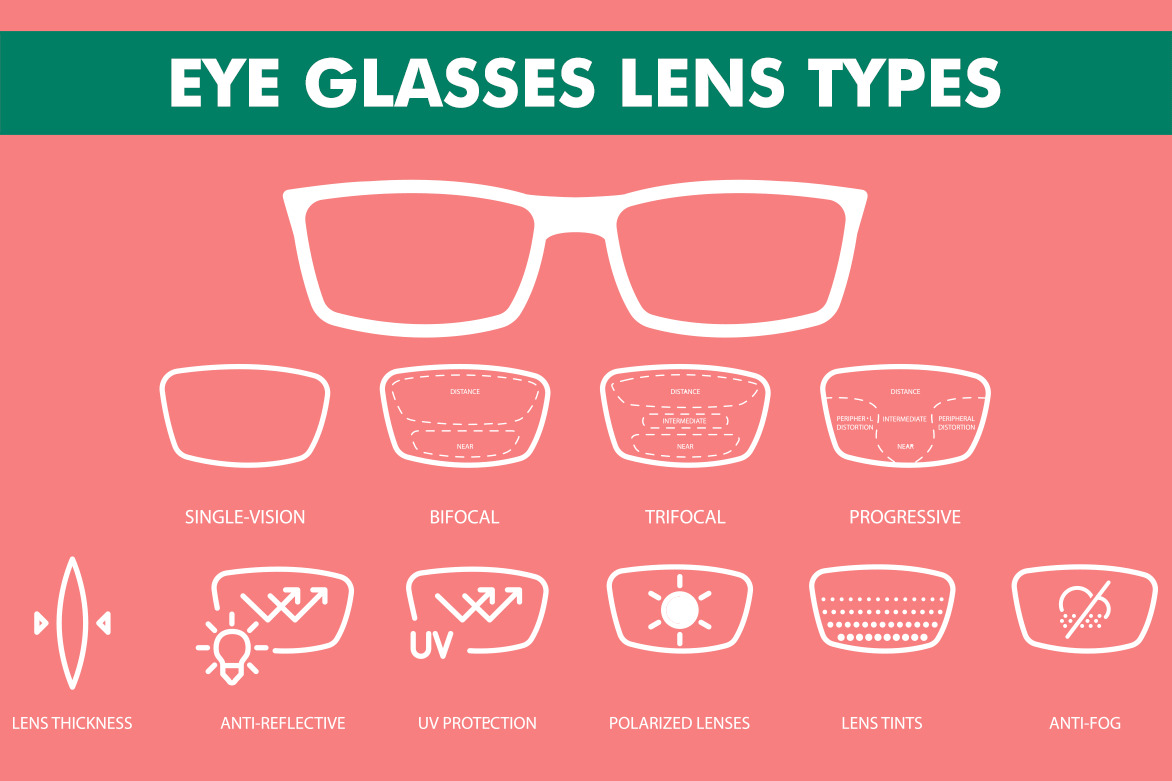
- Single Vision Lenses: These lenses have a single optical power across the entire lens and are used to correct nearsightedness, farsightedness, or astigmatism.
- Bifocal Lenses: These lenses have two distinct areas of vision correction, one for distance and one for near vision, separated by a visible line.
- Progressive Lenses: Often called no-line bifocals, progressive lenses offer a gradual transition between multiple focal points, providing clear vision at all distances without a visible line.
- Trifocal Lenses: These lenses feature three zones for distance, intermediate, and near vision, ideal for tasks like reading or working on a computer.
- Photochromic Lenses: These lenses darken when exposed to sunlight and become clear indoors, providing convenience for people who don’t want to carry both glasses and sunglasses.
- Polarized Lenses: Ideal for outdoor activities, these lenses reduce glare and improve visual comfort by filtering out reflected light.
- Computer Lenses: Specifically designed to reduce digital eye strain, these lenses provide the optimal focus for viewing screens and minimise discomfort from extended screen time.
- High-Index Lenses: Thinner and lighter than standard lenses, these are an excellent option for individuals with high power prescriptions who want lightweight glasses with less distortion.
- Aspheric Lenses: These lenses have a flatter, slimmer profile than traditional lenses, reducing distortion and improving aesthetics.
- Prism Lenses: These do not change focus at all. They shift the image sideways, up or down so that two eyes which are not perfectly aligned still land on the same picture. Ophthalmologists prescribe prism for double vision, for squint that has been only partly corrected, and for nerve palsies that leave one eye pulling off centre. Prism is measured in prism dioptres and is either ground into the lens or applied as a temporary film while the underlying problem is treated.
Types of Lens Coatings
Lens coatings can enhance the durability and performance of your glasses, providing extra protection and clarity. Here are the most common types of lens coatings:
- Anti-Reflective Coating: This reduces glare and reflections, allowing more light to pass through the lens for clearer vision and improved aesthetics.
- Scratch-Resistant Coating: Helps protect your lenses from everyday wear and tear, extending their lifespan.
- UV Protection Coating: Blocks harmful UV rays from reaching your eyes, reducing the risk of eye conditions like cataracts and macular degeneration.
- Blue Light Blocking Coating: Filters out blue light emitted by digital screens, reducing eye strain and improving sleep quality.
By understanding the different kinds of lens coatings, you can choose one that aligns with your lifestyle and visual needs.
How to Choose Lenses Based on Lifestyle?
Choosing a suitable type of spectacle lens also depends on your lifestyle. Here are some considerations to help guide your decision:
- Outdoor Enthusiasts: If you spend much time outdoors, polarised lenses can reduce glare and provide better visual comfort.
- Digital Device Users: If you spend hours in front of a computer, lenses with anti-glare filters can help reduce digital eye strain. Although popular, blue light filters are not scientifically validated for their benefits.
- Frequent Travelers: For those who move frequently between indoors and outdoors, photochromic lenses are convenient for adapting to changing light conditions.
- Strong Prescriptions: If you have a strong prescription, high-index lenses are thinner and lighter, offering more comfort without compromising vision quality.
Comparing Different Types of Lenses
To help you further understand the different types of eyeglass lenses, here is a quick comparison chart:
| Lens Type | Best For | Key Feature |
| Single Vision | Basic vision correction | Simple, one optical power |
| Bifocal | Distance and near vision | Two distinct optical powers, with a visible line |
| Progressive | All-distance vision | Seamless transition between focal points, without any line on the glass |
| Photochromic | Indoor and outdoor transitions | Automatically darkens in sunlight |
| Polarized | Outdoor activities | Reduces glare and enhances contrast |
| High-Index | Strong prescriptions | Thinner, lighter lenses |
| Aspheric | Aesthetics and reduced distortion | Slimmer, flatter lenses |
So, the next time you visit an optical store or an eye hospital, don’t forget to discuss the different types of lenses, their materials and coatings available with your optician. Consult your eye care professional for personalised advice tailored to your unique vision needs.
How To Maintain Your Optical Lenses
Whichever of the types of eyeglass lenses you end up with, they usually fail long before the prescription does, and almost always for avoidable reasons.
- Rinse before you wipe. Dry dust dragged across a lens is what puts the fine scratches there. Run it under water first, then use a drop of mild soap.
- Keep household glass cleaner away from them. Ammonia and alcohol strip anti-reflective coating over a few months.
- Use a microfibre cloth and nothing else. A shirt tail, a tissue and a paper napkin are all abrasive.
- Put them in the case rather than face-down on a table. The front surface picks up most of its damage from being set down.
- Do not leave them on a car dashboard. Heat can craze a coating permanently.
- Get the power rechecked every year, even when the lenses look fine.
Most opticians suggest replacing lenses every one to two years, sooner if the coating has started to haze. Hazing shows up as glare around headlights at night well before you notice anything during the day.
Common Mistakes When Choosing Lenses
The same five mistakes come up whichever of the types of eyeglass lenses someone is choosing between.
- Picking the frame first. A deep, very narrow or oversized frame can rule out the lens you actually need. Progressive and high-index lenses both have minimum fitting heights, and people usually find this out after they have paid for the frame.
- Dropping coatings to save money. Of all the lens coatings for glasses, two repay their cost outright. Anti-reflective coating on someone who works at a screen is not an upsell, and UV protection on a lens worn outdoors in India is not optional.
- Buying on material price alone. Lens materials for glasses are not interchangeable. A cheap plastic lens in an active life scratches within months, and polycarbonate vs glass lenses is not really a quality argument; it is a safety one. It matters most for children and for anyone playing sport.
- Wearing an out-of-date prescription. Most people compensate for a wrong power by squinting, then blame the new lenses for the headaches.
- Ignoring what you actually do all day. A night driver, someone on a screen for nine hours and someone working outdoors need three different lenses, even with the identical prescription.
Children’s Lenses: Safety Tips
Children break glasses. That is the design brief, and it narrows the types of eyeglass lenses worth considering to two.
- Polycarbonate or Trivex, always. Both resist impact far better than glass or standard plastic, and glass has no place in a child’s frame.
- Scratch-resistant coating, because a child’s lens gets cleaned badly and often.
- UV protection for outdoor play, which matters given how much of the school day in India happens in bright light.
- Flexible frames with adjustable nose pads and spring hinges, so the fit survives both growth and being sat on.
- A spare pair. A child who is without glasses for two weeks loses ground in class, and that is harder to fix than the frame.
When Glasses Aren’t Enough: Permanent Vision Correction
Everything above is about managing a prescription well. There is a second option, which is not having one.
If you have worked through materials, coatings and frames more than a couple of times, the running cost is worth adding up honestly: a new pair every year or two, prescription sunglasses, a separate computer pair, a replacement after a scratch, and an hour at the optician each time. Refractive surgery replaces that with a single procedure.
Planet Lasik, powered by Centre for Sight, offers LASIK, SmartSurf, SMILE, Contoura Vision and ICL. LASIK, SMILE and Contoura Vision reshape the cornea so that light focuses on the retina without help. ICL takes a different route and places a soft lens inside the eye, which is the answer for high power or for a cornea too thin to reshape safely.
Not everyone qualifies, and that is the part worth saying plainly. Your prescription needs to have been stable for roughly a year. Corneal thickness, pupil size, tear film and retinal health all have to check out. Some people are assessed and told no, and told why. The assessment decides, not the brochure.
Frequently Asked Questions
What type of eyeglass lenses are best?
The best lens for your spectacles depends on your vision needs, prescription, and lifestyle. Consult with your eye care professional to determine the most suitable one for you.
What is the best material for eyeglass lenses?
Polycarbonate lenses are a popular option for glasses because of their high level of impact resistance. However, each material comes with its own advantages and disadvantages, depending on your lifestyle and prescription strength. Explore all and consult with your eye care professional find the best option for you.
Which lens type is best for computer work?
The best eyeglass lenses for computer work are single vision lenses set for screen distance with an anti-reflective coating, which opticians sell as computer lenses. They put the clear zone at roughly 50 to 70 cm instead of at infinity, so you are not looking through the distance part of the lens all day. If you are over 40, an occupational or office progressive covers the screen and desk better than a standard progressive, which gives you only a narrow intermediate band. Blue light blocking lenses are heavily marketed for screen work, but the evidence that they reduce strain is weak. Screen distance, lighting and break frequency do more.
Are progressive lenses better than bifocals?
For most people, yes, but not for everyone. Progressive lenses give you the intermediate distance that bifocal lenses skip, and there is no visible line. The trade-off is a narrower clear corridor and some peripheral softness that takes one to two weeks to adapt to. Anyone who needs a wide, stable reading field, or who has tried progressives before and given up, is often better served by bifocals. Progressives also cost noticeably more.
How often should I replace my glasses lenses?
Every one to two years for most adults, and more often for children. Two things drive it. The prescription moves, and the coatings wear. Anti-reflective coating hazes with age, and you will notice it as glare around headlights at night before you notice it in daylight. Get the power checked once a year even when the lenses look fine.
Can I get LASIK instead of wearing glasses?
Often, yes. LASIK corrects myopia, hyperopia and astigmatism by reshaping the cornea, and for suitable eyes it removes the need for distance glasses entirely. The conditions are a prescription that has been stable for about a year, enough corneal thickness and healthy eyes. Where the cornea is too thin, ICL is the usual alternative. Reading glasses after 40 are a separate question and may still be needed later.
References
- American Academy of Ophthalmology. Eyeglasses: How to Choose Glasses for Vision Correction. https://www.aao.org/eye-health/glasses-contacts/glasses
- American Academy of Ophthalmology. Pros and Cons of Progressive Lenses. https://www.aao.org/eye-health/glasses-contacts/pros-cons-progressive-lenses-computer-glasses
- American Academy of Ophthalmology. Recommended Types of Sunglasses. https://www.aao.org/eye-health/glasses-contacts/sunglasses-recommended-types
- American Optometric Association. Vision and Vision Correction. https://www.aoa.org/healthy-eyes/vision-and-vision-correction
- National Eye Institute. Refractive Errors. https://www.nei.nih.gov/eye-health-information/eye-conditions-and-diseases/refractive-errors